
Last Updated on July 21, 2026 by Dee
The Alternative to Academic Perspective Drawing
Would you like to draw with more accuracy and more realistic depth? Intuitive perspective art is a method of drawing where the artist uses their ‘eye’ and observational skills to create a sense of perspective in an artwork.
During the Renaissance period in art, artists and scientists like Leonardo DaVinci developed a technique to create the illusion of three-dimensionality on a two-dimensional surface. This is called perspective drawing and has played a fundamental role in the development of drawing accurate scenes since then.
Architects, draftsmen, designers, and artists use the basic principles of perspective drawing in order to create images that are true to reality and give the viewer a sense of what the image would look like in actual, living, space.
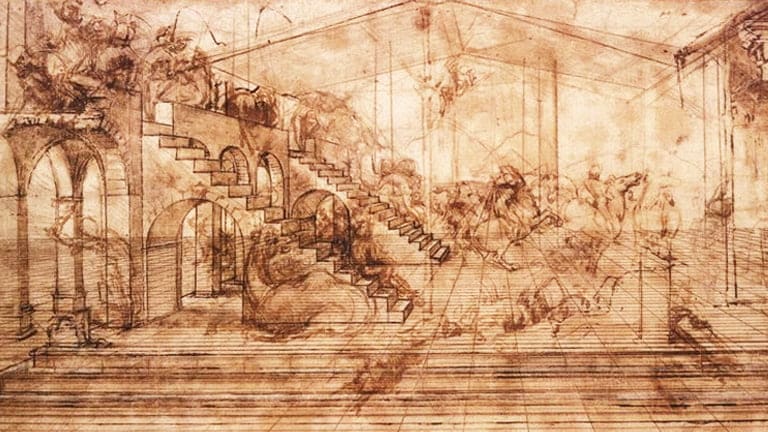
So, what does perspective drawing involve?
Perspective drawing involves drawing a horizon line with a vanishing point. The artist will include directional lines moving towards the vanishing point. In one-point perspective, there is one vanishing point. In a two-point perspective, there are two vanishing points, and so it goes on.
Perspective drawing requires one to use a ruler and to go about mathematically plotting out the image.
This is all good and well, but it is a time-consuming exercise and artists often say they struggle when it comes to drawing organic subject matter. Organic subject matter has more curvy outlines and contours and doesn’t always conform to the rules of perspective.
So how do we get around traditional perspective drawing?
To break the rules, we must first understand the rules. In other words, you must understand the principles of perspective in art before you follow your intuitive sensibility. Essentially, you must understand the rules, but use your ‘eye’ to intuitively complete your drawing.
Sketch out your plan
When you have decided upon your subject matter, you can start sketching your image. By using loose light marks, you are able to work over areas that don’t appear accurate. By working in this way, you can work at a speed and get an overall sense of your composition quite quickly.
Think about what you understand about perspective in art, but work intuitively. Try not to haul out your ruler. Sketch, resketch, and alter your subject matter until it ‘looks right’.
Stand back
It is very easy to get absorbed into a drawing project and forget about the rest of the world for a while. Before you know it, hours have passed. This is all good and well, but it really is important to step back and reflect on your work. Ask yourself, ‘what is working?’, ‘what isn’t working?’, ’How can I improve’?
Go for a quick stroll, make a cup of tea and look at something else for a few minutes. Taking a break really helps you to see your subject matter with new eyes.
Get a friend’s opinion…
Get advice from a trusted friend or family member. Ask them what they think you need to work on. You can post your image onto an online community group to get some constructive criticism too.
Exercises we can use to get better at drawing intuitive perspective art.
Drawing is about ‘seeing’. With all aspects of drawing, in order to get better at drawing, we must spend time observing our subject matter.
Try any one of these drawing exercises in order to improve your observational skills:
- Upsidedown drawing
- Drawing with your non-dominant hand
- Drawing with your eyes closed
- Contour drawing
[Related Article: 11 Top Tips to Improve Your Drawing!]
Conclusion
Some might argue that intuitive perspective art comes with a natural progression in the development of artistic skill. However, there are certainly many ways for the beginner artist to practice using intuitive perspective art to build confidence in their art-making abilities.
If you enjoyed this post, maybe you would like to read about other drawing exercises…
Other articles you may enjoy…
How to create the illusion of depth in art (2022)

Intuitive Perspective Drawing: FAQ
What is intuitive perspective art?
It’s a way of drawing depth using your eye and observational skills rather than rulers and plotted vanishing points. You let your judgement guide the sense of three-dimensional space.
How is it different from academic perspective drawing?
Academic perspective uses a horizon line, vanishing points, and a ruler to mathematically plot the scene. Intuitive perspective works freehand, by feel, which is faster and looser.
Do I still need to learn the rules of perspective?
Yes — to break the rules well, you first have to understand them. Learn the principles of perspective, then let your intuition finish the drawing.
Why would I use intuitive perspective?
Traditional perspective can be slow and fiddly, and it struggles with organic, curvy subjects that don’t follow straight lines. Working intuitively lets you capture those subjects more naturally.
How do I sketch intuitively?
Use loose, light marks so you can work over anything that looks off. Sketch, resketch, and adjust until it simply ‘looks right’ — try not to reach for the ruler.
How do I check my drawing is accurate?
Step back and reflect. Take a short break, make a cup of tea, look at something else, then return with fresh eyes. Asking a trusted friend or an online group for feedback helps too.
What exercises improve my observation skills?
Try upside-down drawing, drawing with your non-dominant hand, drawing with your eyes closed, and contour drawing — they all sharpen the ‘seeing’ that intuitive perspective relies on.